

It usually starts innocently enough.
A guest sends a message: “Hi, do you have a room available for Friday night?” You check your notebook, confirm it’s free, reply yes, and ask for their name. They send it. You write it down. The booking is done.
It worked. So you kept doing it.
Then came the group chats. The messages that arrived at midnight. The guest who booked and never showed up. The time two people both thought they had the same room on the same night, and you had to make an awkward phone call to one of them.
If you run a hotel, guesthouse, or lodge in Africa and you manage bookings through WhatsApp, you are not doing anything wrong. You are doing what made sense when you started, with the tools you had. WhatsApp is free, everyone uses it, and it works for a conversation.
The problem is that running a hotel is not a conversation. It is an operation. And the gap between what WhatsApp can do and what your business actually needs gets more expensive every single month.
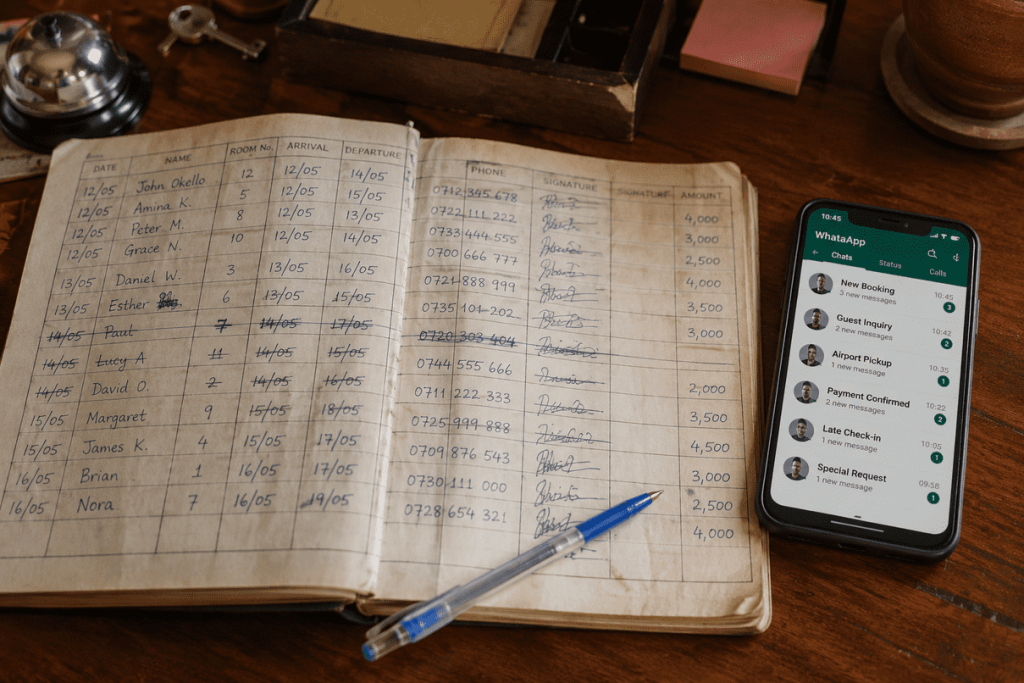
The WhatsApp Booking Problem
WhatsApp was built for personal messaging. It was not built to track room availability, manage multiple bookings simultaneously, send automated confirmations, reconcile payments, or give you a clear picture of what your property looks like tonight.
When you use it for hotel bookings, you are forcing a personal messaging tool to do the job of a business system. The result is a set of very specific, very familiar problems.
Missed messages. Guests send enquiries at odd hours. A message arrives at 11pm, you are asleep, and by the time you see it in the morning the guest has already booked somewhere else. Or worse — you reply, they confirm, but the thread gets buried under other messages and you forget to write it in your book.
Double bookings. You have two people asking about the same room. You are handling both conversations on your phone. You confirm to both of them, realise what happened, and now have to call one guest and explain that their room is no longer available. This does not just lose you a booking. It loses you the guest’s trust, and quite possibly a bad review.
No paper trail. When a dispute arises — a guest claims they paid, or says they booked a different room, or insists they told you they would check out on Sunday not Saturday — what do you show them? A WhatsApp thread from three weeks ago that you have to scroll through to find? WhatsApp conversations are not records. They are chats.
No availability overview. Ask yourself right now: without checking your notebook or phone, how many rooms do you have available this weekend? If you cannot answer in five seconds, your system is not giving you the information you need to run your business.
Staff handovers are a disaster. If you are not on your phone, who handles bookings? If a staff member takes a booking on their own phone, it is in their account, not yours. If they leave, the booking history leaves with them.
Why African Hotels Defaulted to WhatsApp
It is worth being honest about why this happened, because the reasons are real.
International hotel software was expensive, complicated, and built for European or American hotels with IT departments and stable internet connections. Booking systems required credit cards to sign up, charged in foreign currencies, assumed you had a website with its own booking engine, and needed days of training before anyone could use them.
WhatsApp, on the other hand, costs nothing, works on a basic Android phone, runs on 3G without a problem, and every guest already has it. When the alternative was paying for software you could not afford and could not figure out, WhatsApp was the rational choice.
The market did not serve African hotel owners well. So African hotel owners found a workaround.
That workaround served its purpose. But it has a ceiling, and most growing properties have hit it.
The Real Cost of Manual Booking Management
The costs of WhatsApp booking management are rarely counted because they do not appear on a bill. But they are real.
Lost bookings from slow responses. Research consistently shows that travellers book the first property that responds to their enquiry. If a guest asks about a room and you respond four hours later, they have already booked somewhere else. Every hour of delay is a booking at risk.
Staff time on administration. How much time does your front desk person spend each day going through WhatsApp, writing bookings into the register, confirming payments via M-Pesa screenshots, and manually checking availability? For most properties managing bookings this way, it is between two and four hours a day. That is time not spent with guests.
Errors and their downstream effects. A double booking costs you one night’s revenue, possibly a refund, and a relationship with a guest who may never return. A missed payment — a guest who said they would pay on arrival and then did not — costs you the room rate plus the opportunity cost of the room that could have been sold to someone else. These are not hypothetical. They happen.
No visibility for decisions. To grow a hotel, you need to know your occupancy rate, your average revenue per room, your busiest months, your most popular room types. None of that information exists in a WhatsApp thread. You cannot manage what you cannot measure.
What a Proper Hotel Booking System Actually Does
A booking system is not just a digital notebook. It changes the entire way your property operates.
Availability is always current. When a room is booked, it is marked unavailable — automatically, immediately, everywhere. No room can be double-booked because the system simply does not allow it.
Guests get instant confirmation. The moment a booking is made, the guest receives a confirmation. Not a WhatsApp message you typed out manually at 10pm. An automatic confirmation with all their booking details.
Your front desk has one clear view. Every person on your team sees the same information: which rooms are occupied, which are available, which guests are arriving today, which are checking out. There is no version living in someone’s notebook and another version in someone’s phone.
Payments are recorded automatically. Whether a guest pays by M-Pesa, PesaPal, cash, or bank transfer, the payment is logged against their booking. You can see at any moment who has paid and who has a balance outstanding.
You can see your business at a glance. Occupancy tonight. Revenue this week. Which room types are most popular. How many bookings came in this month compared to last month. This information exists, it is current, and it takes one click to see.
How to Transition from WhatsApp to a Booking System Without Losing Your Guests
The biggest fear most hotel owners have is not about the software. It is about the guests. My guests are used to WhatsApp. They will not want to change.
Here is the truth: your guests do not care how you manage your bookings internally. They care that their room is ready when they arrive, that someone responded to their enquiry, and that checking in is smooth. A booking system makes all of those things better, not worse.
Here is how to make the switch without disrupting your guests:
Start running both systems in parallel for two weeks. Continue receiving WhatsApp enquiries, but enter every booking into your new system. Use this period to get familiar with the software before you depend on it completely.
Add your booking link to your WhatsApp business profile. Most booking systems generate a direct booking link. Put it in your WhatsApp status, your profile, and your auto-reply message. Guests who want to book directly can do so without you having to respond manually.
Train your front desk person first. They will be the daily user. Get them comfortable before you launch. If they understand the system, the transition is smooth. If they do not, they will revert to the old way.
Move your existing bookings in. Spend one afternoon entering all your upcoming reservations into the system. This is the last time you will do manual data entry. From that point, everything lives in one place.
Tell your regular guests. Send a simple WhatsApp message to your top guests: “We have upgraded our booking system. You can now book directly at [link]. Your details are already saved.” Most guests will see this as a sign that your property is professional and growing.
Within a month, you will find it difficult to remember how you managed without it.
What to Look For in a Booking System for Your Property
Not all hotel software is the same. When evaluating your options, look for these things specifically:
- Built for Africa. Does it support M-Pesa and local payment methods? Is pricing in KES or a currency you can actually pay? Is support reachable in your time zone?
- Works on mobile. You and your staff run your business from your phones. The system should work just as well on a smartphone as on a desktop.
- Easy enough for your team. If your front desk receptionist cannot figure it out in an afternoon, it is too complicated.
- Affordable at your scale. You should not need to be running 50 rooms to justify the cost. Good hotel software should be accessible to a 10-room guesthouse.
- Grows with you. What happens when you open a second property? Or want to list on Booking.com? The system should be able to grow alongside your business.
You Have Already Done the Hard Part
Building a hotel or guesthouse from nothing — filling rooms, delivering good service, managing staff, keeping guests coming back — that is the genuinely hard work of hospitality. Managing your bookings properly is one of the few things that actually gets easier as you scale, provided you have the right system underneath you.
WhatsApp got you here. It will not get you to where you want to go.
The good news is that switching is simpler than it sounds, and the difference in how your property runs — and how your days feel — is immediate.
Ready to make the switch?
Hbooka is built specifically for African hotels, guesthouses, and lodges. Mobile-first, M-Pesa ready, and set up in under 10 minutes. Start your free trial — no credit card required.
Questions? Chat with us on WhatsApp — we will help you set up the system that means you never have to manage bookings on WhatsApp again.